Free printable open house sign-in sheet
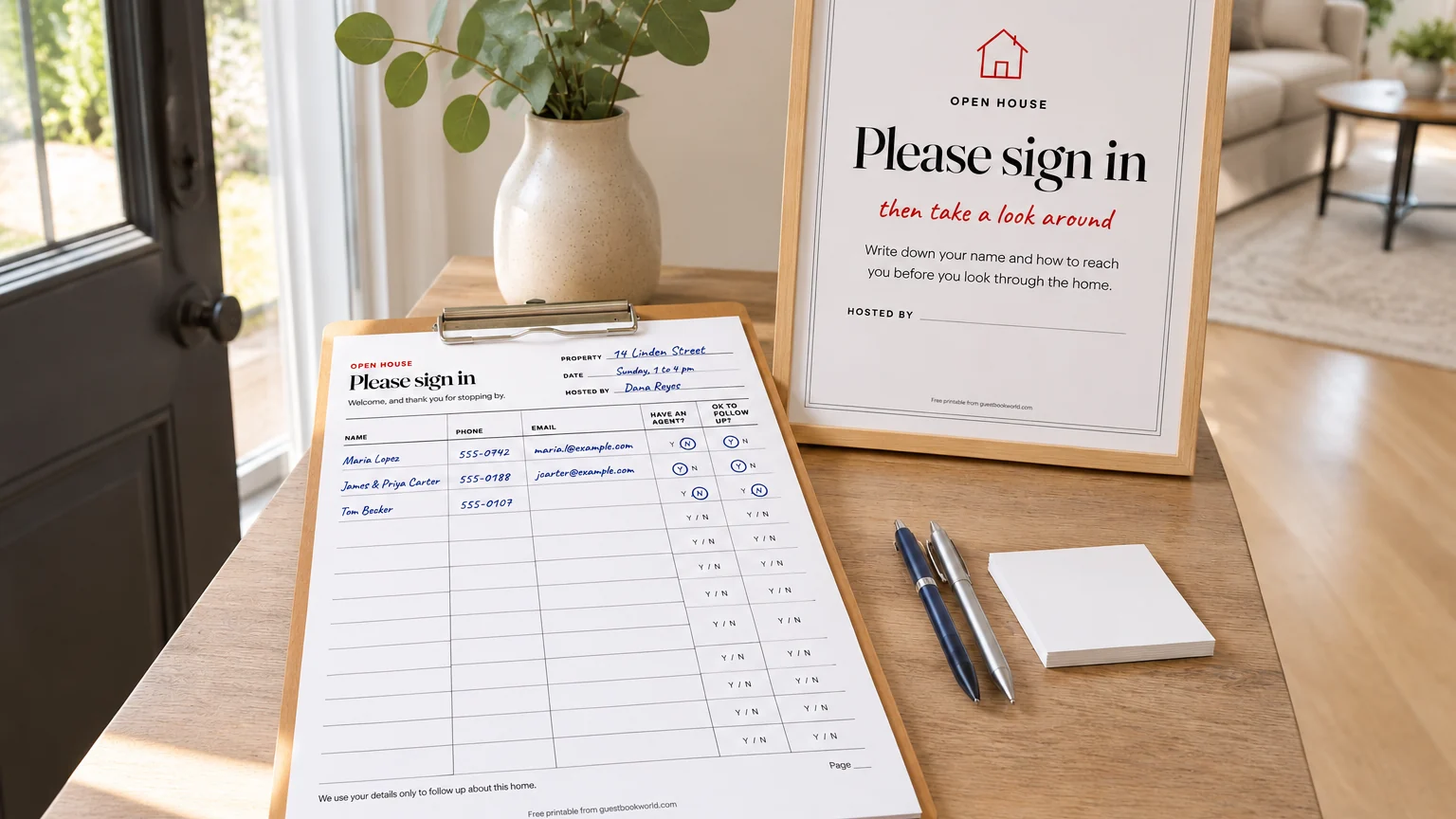
Free printable open house sign-in sheet
Three pages: the sign-in sheet with 15 lines, four visitor cards to cut out, and an 8 by 10 inch Please sign in sign with crop marks. Free to print and copy.
An open house sign-in sheet is the page by the front door where visitors write their name and how to reach them before they walk through the home. Ours is free to print in US Letter and A4, with a line per visitor for their name and how to reach them, plus two yes or no boxes: whether the visitor has an agent, and whether you may follow up. It comes with visitor cards for anyone who would rather keep each visitor’s details private, and a sign for the table.
What is in the download
- The sign-in sheet. Lines at the top for the property, the date and who is hosting, then 15 rows for contact details, a “Have an agent?” column and an “OK to follow up?” column where visitors circle Y or N. A short line at the bottom says you only use the details to follow up about the home, and there is space for a page number when one sheet is not enough.
- Visitor cards, four to a page. Each card asks for the same details plus an address, how the visitor heard about the open house and anything they want you to know, and ends with a box to tick: “You may contact me about this home.”
- A “Please sign in” sign, 8 by 10 inches with crop marks, that fits a standard frame. It has a line for the host’s name.
The files are vector PDFs, so a print shop can print the sign larger without blur.
What to ask visitors
Ask for what you will actually use. A name with a phone number or an email address covers the follow-up call or message. The National Association of Realtors goes further in its safety advice: its tips for a safe open house, an archived page from 2012, say to have all visitors sign in with their “full name, address, phone number and email.” That is why the cards have an address line. The open sheet leaves it out, since every later visitor can read it.
The two yes or no columns save a conversation each. “Have an agent?” tells you before you talk numbers whether a buyer’s agent is involved. “OK to follow up?” gives you a clear answer to look at later. If you call visitors afterwards, a ticked box helps: the Federal Trade Commission’s Do Not Call FAQ says companies can call people who have “given them written permission to call.” Your brokerage and your state may have their own rules on top of that.
Leave off anything sensitive. Questions about income, savings or a mortgage pre-approval belong in a private conversation, not on a sheet the next visitor can read.
A shared sheet or a card per visitor
The sheet is the quicker of the two. Its weak spot is privacy: everyone who signs can read the names and phone numbers above their own line.
The cards fix that. Each visitor fills in a card of their own and drops it in a box or a folder, so their details are never on display. They take a little longer to fill in, and you need a few pens and a hard surface, but they suit a busy open house or a neighborhood where people know each other.
You can also use both: the sheet for quick visitors and the cards for anyone who hesitates to write their number on an open list. Churches face the same choice with first-time guests, and our church visitor cards use the same private card idea.
Setting up the sign-in table
- Put the sheet on a clipboard by the door with two pens that work, and the framed sign behind it where people see it as they come in.
- Fill in the property, the date and your name before the first visitor arrives, and start a fresh sheet for every open house.
- Greet visitors at the table and ask them to sign in before they look around, rather than after, when some will have slipped out.
- Copy the details into your own contact list the same day, then keep the sheets somewhere locked, or shred them once you no longer need them.
The wording on the sign is plain on purpose. For other occasions where people sign at a table, our guide to guest book sign wording has more examples.
What about a digital sign-in?
Some agents use a tablet app that collects the same details and sends a thank-you message, and several of them show up next to the free templates in search results. They make sense if you hold open houses every weekend. For an occasional open house, paper costs nothing and works without a charged battery or Wi-Fi.
One thing that does not fit here is a public guestbook like ours. Messages in a guestbook are meant to be read by other visitors, so it is the wrong place for phone numbers and email addresses. A guestbook suits notes people are happy to share, such as a vacation rental guestbook where guests leave tips for the next ones. Keep contact details on paper or in your own tools.
Quick answers
What should an open house sign-in sheet include? The property, the date and the host at the top, then each visitor’s name, phone and email, whether they have an agent, and whether you may contact them.
Is the sign-in sheet free? Yes. Print as many copies as you need, for your own open houses or your whole office.
Letter or A4? Both are in the download box under the picture. The layout is the same; the rows stretch to fill the taller A4 page.
Can a visitor skip the sign-in? They can, and some will. A friendly ask at the door works better than a rule, and the cards help people who do not want their details on an open list.