Book of condolence: what to write (40 examples)
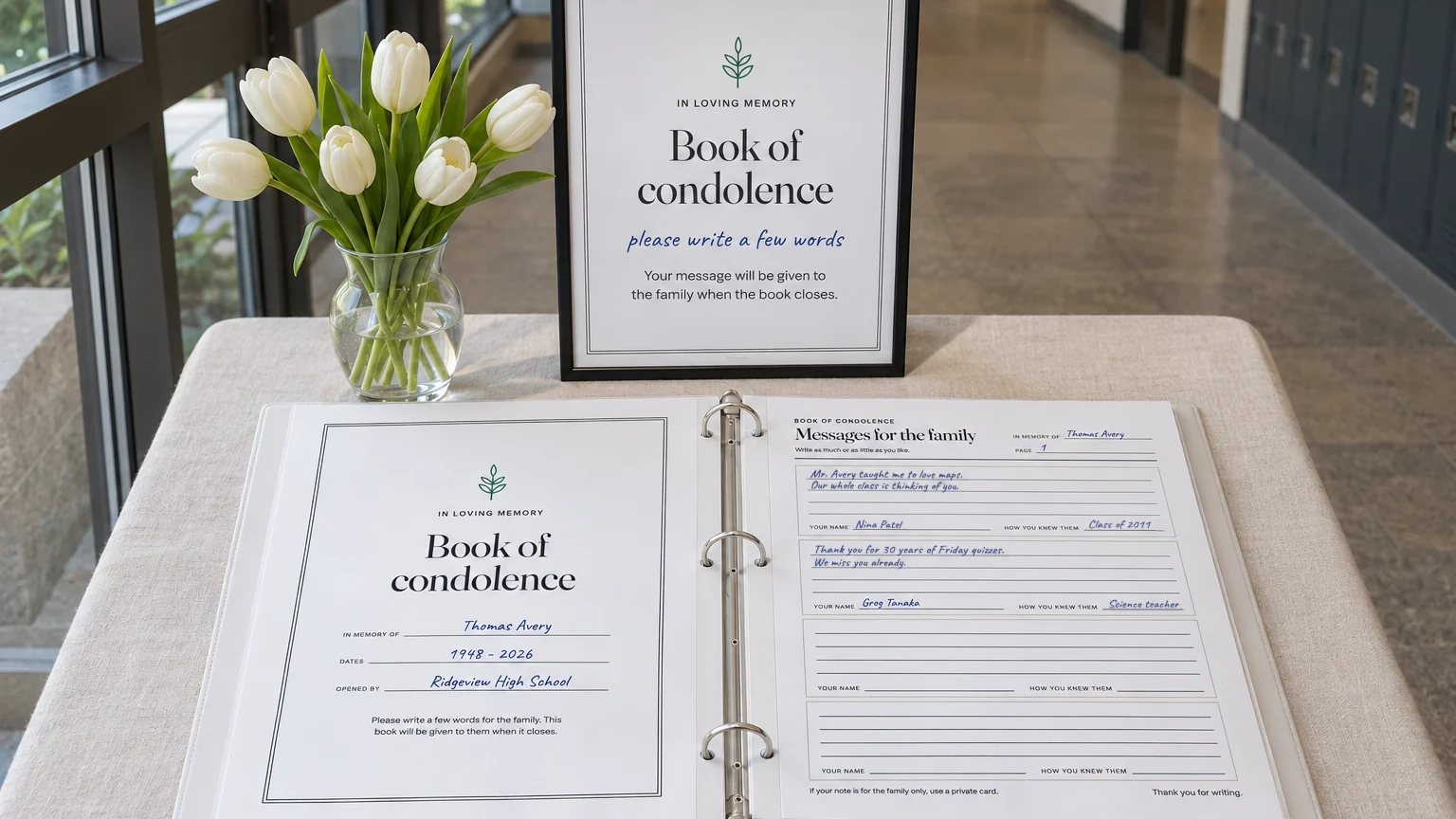
Free printable book of condolence
Four pages: a title page, a message page to print as often as you need, four cards for private notes and an 8 by 10 inch sign for the table. Free to print and copy.
A book of condolence is a book that a workplace, a school, a church or a town opens after someone dies, so that people can write a few words to the family. Two or three sentences are enough: say you are sorry, add one true thing about the person and sign your name.
Below are 40 example messages, sorted by how you knew the person. If you are the one opening the book, there is a step-by-step list further down, and a free printable set with a title page, message pages, cards for private notes and a sign for the table.
What a book of condolence is
Most people meet one at work or in a public building. Someone dies, and a book appears on a table near the entrance, with flowers and a pen beside it. Wikipedia defines it as a book where people record their condolences after a death or a great tragedy, and says that once a book closes it goes to the relatives or into an archive.
The custom is old. After Abraham Lincoln was assassinated, the official condolences were printed as a leather-bound volume by the Government Printing Office in 1867, the same article notes. It is also still in use. When President Jimmy Carter died in December 2024, the White House Historical Association put out an official condolence book for the public to sign at its visitor center in Washington. The Carter Center ran one online, and by its own count that book took in over 23,000 messages from 155 countries, provinces and territories.
Most books are far smaller. An office opens one for a colleague, a school for a teacher, a club for a longtime member. The purpose is the same each time: people who cannot go to the funeral, or who never met the family, get a place to say something, and the family gets to keep it.
Book of condolence or funeral guest book?
A funeral guest book records who came to the service. A book of condolence collects what people wanted to say, including people who could not be there.
| Book of condolence | Funeral guest book | |
|---|---|---|
| Where it sits | A workplace, a school, a church, a town hall, or online | The funeral home or the place of the service |
| Who sets it out | An employer, an organization or a community | The family or the funeral director |
| How long it is open | Several days or weeks | The visitation and the service |
| What people write | A message to the family | Their name, and often how they knew the person |
| Where it ends up | With the family, or in an archive | With the family, who use it for thank-you notes |
Many people sign both. If you are about to sign the register at a service, our guide on what to write in a funeral guest book covers that single line. The rest of this page is about the other book, the one with room for a message.
What to write in a book of condolence
A message has three parts, and each can be a single sentence:
- Your sympathy, addressed to the family. They are the people who will read the book.
- One true thing about the person: something they did, said or taught you.
- Your name, with a few words that help the family place you, such as your team, your class year or your street.
Use the person’s name. If you did not know them well, the first and third parts are enough. The next person in line can read your message too, so write what you would be willing to say out loud. The same shape works in a memorial book at a service.
For a colleague
The family may know little about the working day. A detail from it is something only you can give them.
- “To Maria’s family: she trained me in my first week and checked on me every week after that. I am so sorry. Dev Shah, Accounts”
- “Tom kept a jar of mints on his desk for anyone having a bad day. The whole floor will miss him. With sympathy, Karen Wu”
- “Twelve years on the same shift, and I never heard Luis complain once. He was the best of us. Andre Brooks, Dock 4”
- “I only worked with Priya for a year, and she taught me how to run a meeting that ends on time. Thinking of her family. Sam Ortiz”
- “Ms. Daniels hired me when nobody else would. Everything I have built since started in her office. With gratitude, Joy Akins”
- “Frank answered every question I ever asked him, including the ones I asked twice. My condolences to his wife and sons. Paul Reid, Engineering”
For a friend
When the book is at your friend’s workplace or church, the family will read it as well. Tell them what the friendship was.
- “Jen and I met in the registration line in 1994 and never stopped talking. I will miss her every day. Love to you all, Beth Kowalski”
- “Marcus was the first to show up when my car broke down and the last to leave when we moved. I am here for anything you need. Dana Price”
- “To Ed’s family: he talked about you all the time. You were his favorite subject. With love, Ron and Carla Meyer”
- “Thursday coffee will not be the same. Thank you for 20 years of bad jokes and good advice, Stan. Phil Navarro”
- “Aisha made friends with everyone in a room and then introduced them to each other. I am one of the people she collected. Nora Haddad”
- “I am so sorry. Pat remembered the names of my kids and asked about my mother’s hip every time we spoke. Lee Ann Marsh”
For a neighbor or someone in your community
A teacher, a coach, a shop owner or a pastor reaches people the family has never met. Say where you fit.
- “Mrs. Flores taught three of my children to read. Half of this town learned its letters in her classroom. The Bennett family, Oak Street”
- “Coach Williams drove me home after every practice in 2009 because he knew my mom worked nights. I never forgot it. Jamal Greene”
- “Mr. Chen kept his hardware store open late the night our pipes froze. The neighborhood will miss him. Lisa and Omar Aziz”
- “Pastor Ruth sat with our family at the hospital for two nights. We are praying for hers now. The Douglas family”
- “Dr. Mehta looked after four generations of my family. My condolences to his children. Helen Brandt, a patient since 1988”
- “Gene ran the food pantry every Saturday for 15 years. I volunteered beside him for six of them and never saw him sit down. Teresa Gomez”
For a public figure you never met
Books for a mayor, a musician or a president fill up with messages from strangers. Write what the person’s work meant in your own life.
- “I never met Mayor Linden, but she answered my letter about the crosswalk on Fifth Street, and the crosswalk got built. Thank you. Rob Lang, Ward 3”
- “His songs played at our wedding and at my father’s funeral. Thank you for the music. My sympathy to his family. Ann Souza, Tulsa”
- “I was nine when I watched her win gold, and I joined the swim team the next week. With respect, Kayla Morris”
- “Thank you for a lifetime of service to this state. Our family is thinking of yours. The Jacksons, Macon”
- “My late husband served under the General in 1968 and spoke of him with respect all his life. I am signing for both of us. Doris Whitfield”
On behalf of a team, a class or a club
One person can sign for a group. Name the group, and let the others add their names underneath if there is room.
- “With deepest sympathy from everyone at Lakeside Elementary. Mr. Grant’s fourth graders are planting a tree for him by the playground.”
- “From the Tuesday night bowling league: lane 6 is yours forever, Hank. We are thinking of your family.”
- “On behalf of the Class of 1987, our sympathy to the Morales family. Elena was the heart of every reunion.”
- “The volunteers of Station 12 send our condolences. Chief Barrett served this town for 31 years and taught most of us the job.”
- “From all of us at Rivera and Sons Bakery: Joe opened the doors at 4 a.m. for 22 years. The first loaf tomorrow is for him.”
After an accident or a disaster
Sometimes a book opens for people you never knew, after a fire, a crash or a storm. A plain message is the right one.
- “We did not know the families, and we are grieving with them. A family from Pine Street”
- “Our town is smaller today. We are thinking of every family. Marta and Luis Ortega”
- “Thank you to the firefighters and nurses who worked through that night, and our deepest sympathy to everyone who lost someone. Ben Adler”
- “I drive that road every day and will think of them each time. With sympathy, a neighbor”
Short and simple messages
When you are stuck, or the line behind you is long, one sentence and your name will do.
- “With deepest sympathy to the family.”
- “Our thoughts are with all of you.”
- “You are in our prayers.”
- “Gone too soon and never forgotten.”
- “Thank you for everything, Sam.”
- “Rest in peace, dear friend.”
- “So sorry for your loss.”
- “With love and respect.”
Lines to leave out
The book sits in a public place, and the family may keep it for decades. Some things belong elsewhere:
- How the person died, and any question about it.
- Your phone number, your address or anything else you would not hand to a stranger. Everyone who signs after you can read it.
- Politics, even when the book is for a politician. Thank the person and save the argument.
- Anything long. If you have a page to say, write the family a letter and mention it in the book.
Opening a book of condolence, step by step
If you are setting one up for an office, a school or a club, the work is small, but the order matters:
- Ask the family first. Some families do not want a public book, and others will want to choose the photo.
- Pick a place people pass anyway, such as the lobby, the staff room or the church entrance, and one person who looks after the book.
- Use loose pages in a binder. A spoiled page can come out, and the pages can be bound once the book closes.
- Set the table with a cloth, flowers or a photo, the open book and several pens. For a fuller display, borrow from our memorial table ideas.
- Stand a sign next to the book, so nobody wonders whether they may write in it. Our guide to guest book sign wording has more lines for a memorial.
- Tell people where the book is and when it closes: an email to staff, a note on the door, a line in the newsletter.
- Read the new pages every day, and quietly take out anything unkind.
- Close the book on the date you announced, and take it to the family in person.
Wheatley Parish Council in Oxfordshire, England, wrote its routine down for the death of a senior national figure, and its guidance is a good model. The book opens on the next working day and sits on a table with a black cloth, a photograph or flowers and a supply of pens. Someone stays with it, defaced pages and offensive comments are removed discreetly, and it closes at 5 p.m. on the day after the funeral.
For an office, we would keep the book open through the funeral and for a week after it, so people on leave or on another shift get their turn.
When the book closes, it belongs to the family. The Nixon Library set out a book for President Carter in December 2024, and CBS News reported that the finished book would go to the Carter family.
The free printable pages
The download at the top of this page has four pages, in US Letter and A4:
- A title page with lines for the person’s name, their dates and who opened the book.
- A message page with four spaces. Each one has four ruled lines, a line for a name and a line for how the writer knew the person. Print as many copies as you expect to need, plus a few spare.
- Four cards for private notes. Some people have something to say that is for the family only: they fold a card and leave it in a box or an envelope next to the book.
- A sign for the table, 8 by 10 inches with crop marks, so it fits a standard frame.
Print on thick paper, 28 lb or 32 lb bond in the US or 100 to 120 gsm elsewhere, so the ink does not bleed through.
An online book of condolence
A paper book only reaches people who can walk up to it. An online book of condolence, sometimes called an online memorial book, takes messages from anywhere, which matters when colleagues work remotely or the family lives in another state.
We make a free online memorial guestbook, so weigh this part with that in mind. A memorial guestbook starts unlisted, so only people with the link can find it. You can turn on review mode, and then nothing appears until you have read it, which is the job the person at the table does for a paper book. Pick one of the quiet themes, such as Slate. Put the QR code on the sign, and visitors who would rather not write in front of others can do it later from their phones. When you close the book, you can download every message as one spreadsheet file and print it for the family.
Paper and online work well together. Wheatley’s guidance covers people without internet access: they leave a message at the parish office, and staff add it to the online book. You can also go the other way and slip the printed online messages into the binder.
Memorial book ideas for the pages afterwards
The loose pages are the start of a memorial book. A few ways to finish it:
- Put the title page in front and have the pages bound. A copy shop can add a spiral or a hard cover.
- Add what arrived by other routes: cards, printed emails, the online messages, the order of service.
- Keep the private cards sealed in an envelope inside the back cover, for the family alone.
- Place photos between the pages: the person at work, at the club, with the team.
- Scan everything before you hand it over, so the school or the office keeps a copy. Ask the family before you share the file with anyone.
- Leave a few blank pages at the back for people who want to add a line later.
Quick answers
Is it “book of condolence” or “book of condolences”? Both are in use. The English council above writes “book of condolence”. The office of Canada’s Governor General wrote “Book of Condolences” when she signed the one for President Carter at the US Embassy in Ottawa, and in the United States the White House Historical Association and the Carter Center both say “condolence book”. We sorted out a similar split in guestbook or guest book.
Is the printable free? Yes. Print and copy as many pages as you need.